Petro
Felix AustriaPetro is a sculptor whose art is inseparable from death, domestic attachment, and the work of making a home. First commissioned to create a memorial for Doctor Anger’s deceased wife, he later builds the house that becomes a public curiosity; as Adèle’s husband and an appreciative collaborator with Felix, he remains a quiet center of the household. Stefania’s account gives particular weight to what Petro notices and makes, but also to the labor that allows his family’s life to continue.
Identity and Artistic Practice
Petro is a working artist who has returned to Stanislaviv after studying at the Academy of Fine Arts in Vienna. Doctor Anger hears of the young master on the twentieth anniversary of his wife’s death and seeks him out. Petro rents a decaying wooden house on Siemiradzki Street: its roof leaks, rats scramble beneath the floor, and it stands opposite a gasometer. Yet its unusually large windows make it suitable as a studio, while its garden runs from a nearly impassable tangle into orderly greenhouses, flower beds, and urban vegetable plots. The roughness of the setting and the deliberate cultivation within it mirror an artistic practice that works amid disorder without simply erasing it.
Petro is intensely absorbed in work. Once Doctor Anger commissions a monument to his late wife, Petro begins at once, carving her from white marble so pure that its brightness seems transparent, like ice from Alpine peaks. The image of the sculptor carefully freeing a dead woman from a block of stone gives his craft an intimate, almost bodily character: he does not merely fashion a memorial but releases a likeness from material. His art is therefore bound to funerary labor, yet it also preserves and makes visible the emotional attachments that death threatens to end.
That artistic eye extends beyond marble. Stefania observes that Petro admires forms and surfaces across a wide range of things, even clods of earth, broken glass, and oil stains. She has caught him admiring her strong, straight hair, whose dark sheen turns coppery in sunlight. But his greatest admiration is for Adèle, for whom he has already built a mausoleum. The contrast is telling: Petro’s aesthetic attention can rest on humble or damaged matter, while his devotion to Adèle takes monumental form. His work makes private feeling legible through objects, though the scale of the monument also leaves open how much of love can be expressed through art alone.
Marriage and the House
Petro’s marriage to Adèle is described through a change in her behavior rather than a change in his. He remains firmly planted, figuratively as well as physically, while Adèle begins to look at him with a doglike fidelity. At dinner she lays her palm on his large, rough hand as if they have finally become truly close. Stefania watches the gesture with mixed nausea and sadness, interpreting their new intimacy as a conviction that, instead of bringing a third person into the world, the two have become one being. Her response makes the marriage’s closeness both moving and unsettling: unity appears not as an uncomplicated ideal but as an enclosure Stefania must witness from outside.
Petro begins building the house Stefania sees each morning from Lindengasse. Its intended rectangular form seems to loosen into a vast, undulating shell, like an enormous snail shell discovered in a garden. Projections and wavering contours make the building appear reflected in a distorting mirror. Narrow windows sit beneath slate roofs, while glossy ceramic tiles in reddish brown, gray-green, and blue run around windows, doors, columns, cornices, and arches. The house gathers the same traits that define Petro’s artistic work: attention to material, unconventional form, and the transformation of something domestic into something that draws the eye.
The building becomes a spectacle for passersby. Stefania sees hats and top hats, lace parasols, and elegant walking sticks turned toward the windows while she kneads dough or strains a herbal decoction. The town’s building style is changing as wooden dwellings burn or collapse and give way to brick houses decorated with towers, arches, columns, metalwork, plaster ornament, mosaics, and colored glass. Those newer houses, for all their ornament, seem properly situated; Petro’s house looks like a mirage about to dissolve. His design therefore distinguishes the family home from the city’s developing architectural norm. It is not merely a residence but a conspicuous, unstable-looking work of art that makes private domestic life visible to strangers.
Family, Work, and Recognition
Petro’s artistic partnership with Felix comes into view at a late-autumn gathering in the glass-and-wood refreshment pavilion in Empress Elisabeth Park. The guests admire a charcoal portrait of Adèle, shown with a solemn, prayerful expression. Petro credits Felix with making it and says that he himself supplied only a few corrections. His insistence on naming Felix as the artist gives the boy public recognition rather than taking the achievement for himself. The small qualification about his own corrections does not erase that gesture; instead, it places Petro in the role of an experienced maker who helps another artist’s work reach completion.
Petro’s manner is generally quiet, and the narration says that his eyes speak more than he does. At the gathering he cannot take his gaze from Adèle. When the pavilion’s proprietor, Klaar, presents him with a symbolic little woman’s slipper, Petro places his glass in it, kneels before Adèle, bows his head, and drinks to her health. The gesture turns a toast into a miniature performance of devotion, public and theatrical without requiring a speech. His reserved character thus does not mean emotional detachment: he communicates through sustained attention, crafted objects, and physical acts.
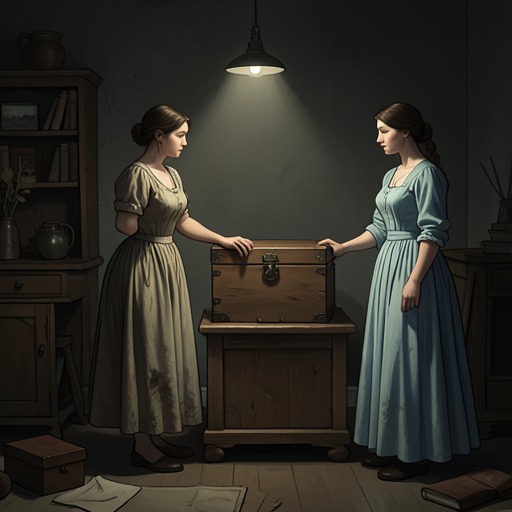
His care also reaches Stefania, whose work sustains the household while remaining easy for its guests to overlook. She describes her routine as preparing, cooking, baking, washing, cleaning, and mending, then keeping silent while the household’s masters eat and forget. Petro takes a tray of dishes from her hands and helps carry it into the kitchen. He tells her that he is grateful, that none of what they have could have been possible without her, and that their house would not be the best house without her; he calls her family. The moment gives explicit recognition to labor otherwise treated as part of a servant’s expected duties. Yet the warmth of Petro’s words does not remove the underlying difference in status: Stefania immediately lowers her eyes, dismisses his thanks as drunken nonsense, and tells him to return to the guests because she has no time to talk.
Meaning and Limits of His Kindness
Petro’s acknowledgment of Stefania is set beside the unequal arrangement that structures her relationship with Adèle. Later, Adèle explains that Petro said the two women were not responsible for their estrangement; he placed much of the blame on her father, who had left them dependent on one another without showing them how to escape that condition. Adèle describes the result as a servant’s resentment of her for falling in love and wanting to marry. She also acknowledges that Stefania has fed her turnip salad for a month, though she hates it, and that she eats it obediently without daring to protest because the women grew up together and saw each other’s dreams. Adèle then admits that she has always been jealous that her father loved Stefania as much as he loved her.
This account places Petro inside a family conflict he can diagnose but cannot, by acknowledgment alone, resolve. He understands that the women’s dependency was imposed and that their resentment has a history; he gives Stefania the name of family, yet she continues to experience herself as the servant whose work is expected and whose feelings must be restrained. His kindness is real and specific—taking the tray, thanking her, crediting Felix—but the household’s intimacy remains entangled with rank, obligation, and old jealousy. Petro’s significance lies partly in this tension: the artist who makes memorials and a remarkable home can see the value in the people around him, while recognition does not automatically undo the conditions that keep them unequal.